

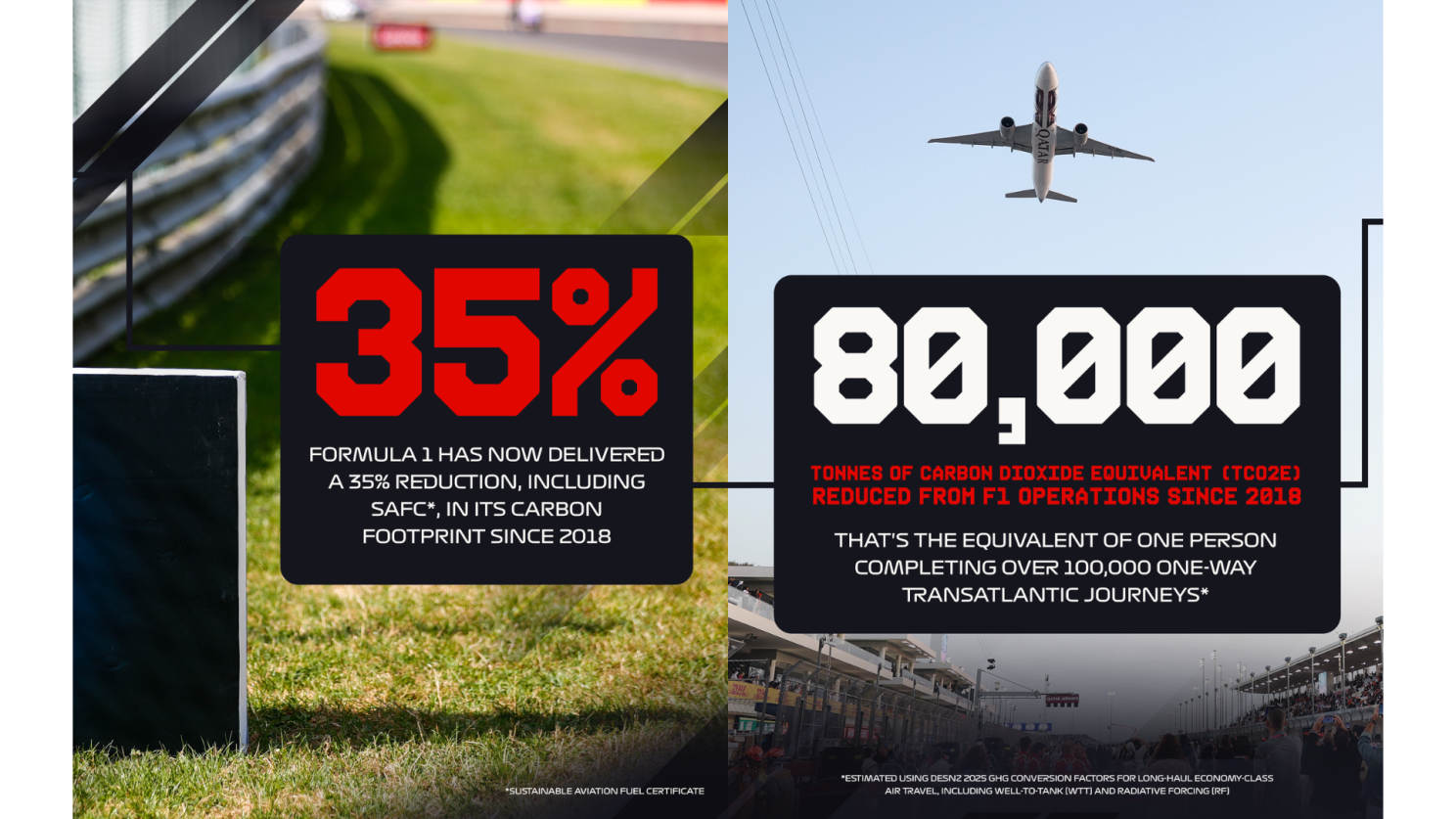
Formula 1 has announced that it has reduced its operational carbon footprint by 35% compared with its 2018 baseline, marking another significant step towards its commitment to become Net Zero by 2030.
According to the sport’s newly released Sustainability Report, nearly 80,000 tonnes of CO₂ equivalent (tCO₂e) have been eliminated from Formula 1’s operations over the past seven years. The latest figures also represent a 12% reduction compared with 2024, highlighting continued progress despite the championship’s expanding global calendar.
Sustainable fuels and smarter logistics drive emissions cuts
One of the biggest contributors to Formula 1’s emissions reductions has been the transformation of its global logistics network.
For the first time, the championship now uses lower-carbon solutions across all three freight modes—air, sea and land. The sport is progressively replacing air freight with sea transport and regional logistics hubs, a strategy expected to remove more than 50% of Formula 1’s broadcast and related freight from air transport by 2030.
Formula 1 also doubled its investment in Sustainable Aviation Fuel (SAF) during 2025. According to the report, this alone reduced more than 20,000 tonnes of CO₂ equivalent, cutting emissions from air charter operations by approximately 40%.
In addition, Formula 1 made its first investment in sustainable maritime fuel, creating a scalable lower-carbon solution for transporting equipment by sea.
Greener race operations across Europe
Race weekends themselves are also becoming more sustainable.
During every European Grand Prix in 2025, Formula 1 powered paddocks, pit lanes and technical centres using alternative energy sources including Hydrotreated Vegetable Oil (HVO), solar energy and battery storage systems.
These initiatives reduced event operation emissions by 17% per race, while promoters continue investing in renewable electricity and cleaner energy infrastructure at host venues.
Sustainability without compromising the spectacle
Formula 1 President and CEO Stefano Domenicali said the results demonstrate that environmental progress and sporting growth can go hand in hand.
The championship has continued expanding its worldwide audience while simultaneously reducing its operational emissions through calendar optimisation, investment in sustainable fuels and improvements in freight logistics.
Ellen Jones, Formula 1’s Head of ESG, added that sustainability now influences every aspect of how the championship is organised, from transporting equipment around the globe to powering race infrastructure during Grand Prix weekends.
She also highlighted the upcoming Future Race Operations Programme, together with the calendar rationalisation introduced for the 2026 season, as key drivers of further emissions reductions over the coming years.
A benchmark for global sport
Formula 1 has often faced criticism for the environmental impact associated with a global championship involving extensive international travel and freight transport.
However, the latest sustainability report suggests that meaningful emissions reductions are achievable without fundamentally changing the championship’s global nature.
Rather than relying on carbon offsets alone, Formula 1 is focusing on operational changes including cleaner fuels, more efficient logistics and lower-carbon energy systems. These measures could provide a blueprint for other international sports that face similar challenges balancing worldwide competition with ambitious climate targets.
With four years remaining before its 2030 deadline, Formula 1 appears to be maintaining steady progress towards one of the most ambitious sustainability commitments in global sport.