

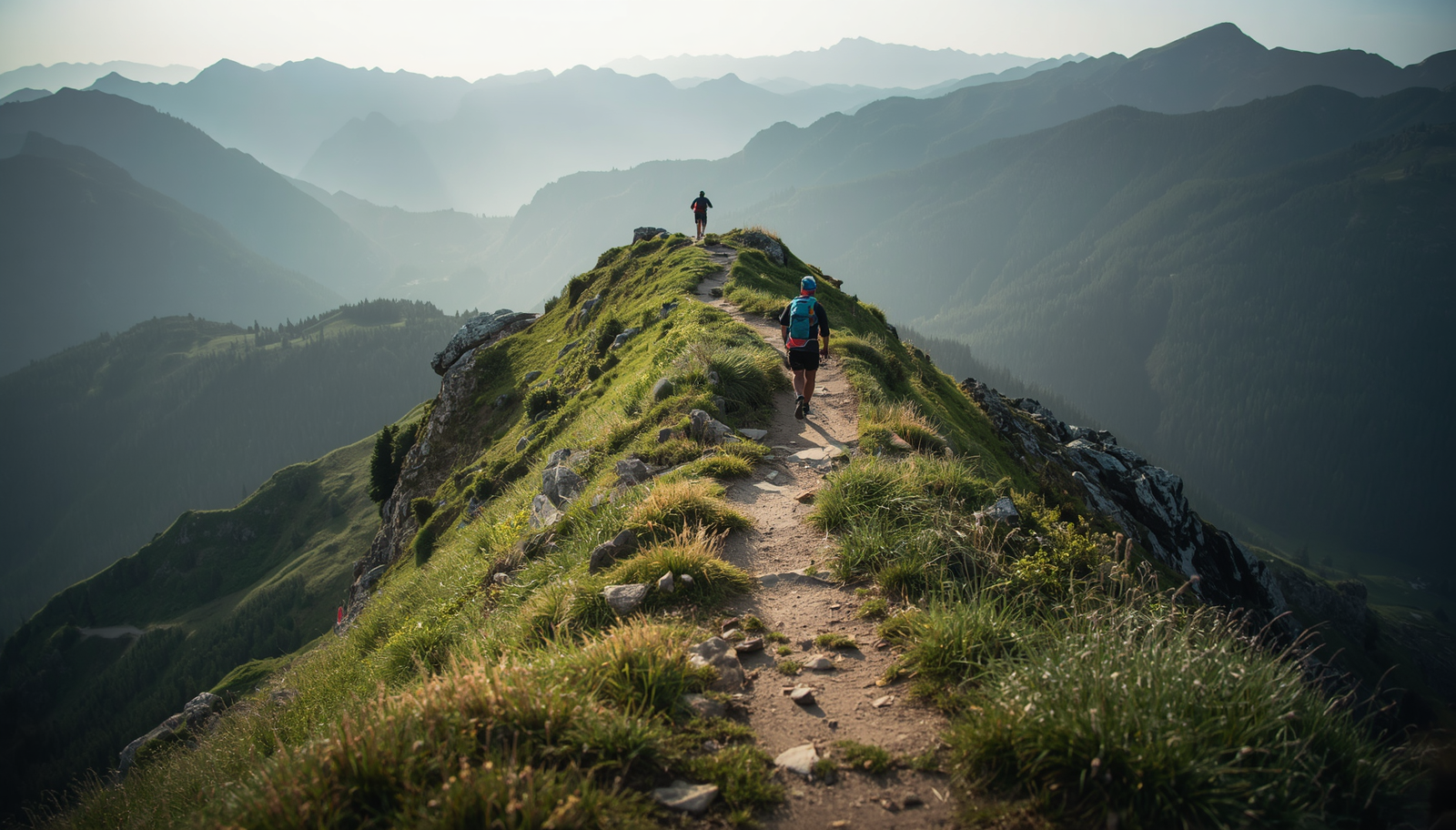
Trail running has always benefited from a powerful narrative. It presents itself as a freer, cleaner and more authentic form of sport, one that takes place in forests, mountains and open landscapes rather than inside concrete arenas or heavily engineered venues. The sport’s identity is built around direct contact with nature: weather, terrain, altitude, silence, exposure and movement through wild spaces.
That narrative still works extremely well. It shapes race films, outdoor marketing campaigns, destination branding and athlete storytelling. It fuels the idea that trail running is somehow closer to nature, and therefore more compatible with it, than many other sports. But as trail running grows into a global event economy, that assumption is becoming harder to defend.
A sport practiced in nature is not automatically good for nature.
In reality, the closer an activity gets to sensitive ecosystems, the greater its responsibility becomes. Trail races do not move through neutral landscapes. They move through habitats, wildlife corridors, fragile soils, breeding areas and mountain environments that are already under pressure from tourism, climate change and increasing human traffic.
For years, trail running has benefited from a visual advantage. Compared with traditional stadium sports, its footprint appears lighter. There are no permanent grandstands, no floodlights, no artificial pitches and no enclosed infrastructure built purely for spectacle. Because the setting looks natural, the sport itself is often perceived as naturally sustainable.
The discussion around sustainability in trail running has often focused on what people can immediately see: plastic waste, aid station practices, reusable cups, litter management or staying on marked trails. These measures matter, and many races have improved significantly in those areas. But they address only part of the problem.
The more difficult questions involve biodiversity, erosion, wildlife disturbance, mobility systems, participant volume, route design and the cumulative pressure created by large-scale events in sensitive environments.
Sports for Nature, an initiative supported by conservation organisations and international sports bodies, has repeatedly highlighted the fact that outdoor sporting events interact directly with natural ecosystems and can damage habitats or disturb wildlife when environmental risks are poorly assessed. The issue is not whether trail running should exist. The issue is whether the sport is willing to examine its impact honestly rather than relying on the comfort of its “nature sport” image.
One of the biggest blind spots in trail running is the difference between visible impact and ecological impact.
A damaged trail section is visible. Forgotten course markings are visible. Overflowing bins are visible. Wildlife disturbance is not always visible at all. A bird abandoning a nesting area, an animal changing its movement patterns or a habitat slowly degrading under repeated pressure rarely produces dramatic imagery. Yet these effects can be significant, especially when races are repeated every season in the same environments.
Trail races concentrate multiple pressures into a short timeframe: trampling, soil compaction, erosion, spectator density, vehicle access, media presence, noise, aid stations and, in some cases, drones or helicopters. Individually, each element may appear manageable. Combined in the wrong place, at the wrong time or at the wrong scale, they create a different environmental equation altogether.
The common argument that “runners stay on the trails” is important, but incomplete. Research on recreational disturbance and wildlife shows that many species react to human presence long before direct physical contact occurs. Some birds, raptors and large mammals can alter their behaviour at considerable distances depending on timing, density and noise levels. Disturbance is not limited to someone stepping off a path. It can emerge from the repeated concentration of human activity itself.
The question is no longer only whether a route is scenic, technically interesting or logistically possible. It is whether the territory can absorb the event without long-term degradation. Can the environment support that number of runners, spectators, vehicles, aid stations and media systems at that time of year? Can local ecosystems tolerate repeated exposure to increasingly large outdoor events marketed around iconic landscapes?
This becomes particularly important in mountain environments, where trail running has built much of its identity. Alpine ridgelines, high-altitude trails, wetlands, forests and protected valleys are not simply visual assets for race organisers or outdoor brands. They are living systems already exposed to growing pressure from tourism, infrastructure development, skiing, hiking, cycling and climate instability.
A race committed to environmental responsibility does not only publish sustainability messaging. It makes difficult choices. It changes a route. It avoids a fragile area. It limits participant numbers. It restricts spectator access. It removes a drone segment. It modifies a race date to reduce ecological pressure. It works with land managers and environmental experts before the event rather than defending decisions afterward.
These choices are not always commercially attractive. Sustainability can reduce convenience, visibility and scalability. It can complicate logistics and frustrate runners who want access to the most dramatic terrain. But if sustainability never changes operational decisions, it remains largely rhetorical.
Biodiversity, however, is only part of trail running’s environmental challenge. The other major issue is carbon emissions, particularly those linked to travel.
For years, environmental discussions in trail running focused mainly on what happened on the course itself. Yet for large international events, the biggest environmental footprint often arrives long before the race begins.
It comes from transport.
The UTMB Mont-Blanc has become one of the clearest examples of this shift in awareness. In its 2024 carbon footprint report, the event estimated total emissions at 18,600 tCO₂e, with transport representing 88% of the overall footprint. Flights alone accounted for 85% of travel-related emissions linked to runners and accompanying persons.
The question is no longer limited to whether runners use reusable cups or dispose of waste correctly. It also includes how participants travel to races, how far they travel, whether they fly, how many accompanying visitors attend and whether event organisers genuinely provide low-carbon alternatives rather than simply encouraging “responsible behaviour.”
UTMB has responded by making mobility a central part of its environmental strategy. The organisation says it aims to reduce its carbon emissions by 20% by 2030 and now places transport policy at the core of its sustainability planning. From 2026 onward, runners meeting low-carbon travel criteria will receive a 30% increase in lottery selection chances, while participants will also face a mandatory carbon contribution linked to their travel emissions.
Whether these measures go far enough remains open to debate, but they represent a significant cultural shift. Mobility is no longer treated as a secondary issue around the event. It is becoming part of the event model itself.
This exposes one of the central contradictions within modern trail running. The sport celebrates closeness to nature while increasingly relying on long-distance travel to consume iconic outdoor experiences. International race calendars, destination marketing, athlete content and social media all reinforce the idea that the most meaningful trail experiences happen elsewhere: higher mountains, more remote landscapes, more prestigious events.
Brands sell aspiration through exceptional landscapes. Race organisers package destinations as experiences. Athletes amplify the visibility of iconic races. Tourism economies depend on the attractiveness of these events. But if participation increasingly depends on repeated flights and large-scale mobility, the environmental narrative surrounding trail running becomes far more fragile.
This does not mean international trail events should disappear. Large races can create local economic value, support mountain communities, strengthen sporting culture and push environmental measurement further than smaller races often do. But the sector can no longer separate biodiversity from carbon emissions, or local environmental impact from global mobility systems.
A trail race does not begin at the start line anymore. It begins when participants decide how they will travel.
That is why the future of sustainable trail running cannot rely solely on individual responsibility. Runners matter, but they do not design the system alone. Event organisers shape incentives. Qualification systems shape travel patterns. Brands shape desire. Tourism offices shape destination appeal. Sponsors shape visibility. Local authorities shape access and infrastructure.
If the entire ecosystem rewards scale, prestige and international mobility, it becomes unrealistic to expect environmental responsibility to rest mainly on individual choices.
The challenge is structural.
It involves designing race calendars that reduce unnecessary travel, improving train access, reducing car dependency around events, integrating biodiversity assessments into route planning and questioning the assumption that growth must always mean larger international participation.
It may also require the sport to accept limits.
Trail running has expanded by selling access, access to landscapes, achievement, emotion and iconic terrain. Environmental responsibility may force organisers and brands to recognise that some environments cannot absorb unlimited exposure without consequences.
That will not be an easy transition for a sport built around freedom, exploration and expansion. But the credibility of trail running’s environmental discourse now depends on its willingness to move beyond symbolic gestures and confront the operational reality of its impact.
None of this requires turning runners into villains. Trail running can create meaningful attachment to landscapes and strengthen outdoor culture. It can support local economies, fund clubs and encourage people to value natural spaces more deeply. But attachment alone does not reduce ecological pressure.
A race can inspire thousands of people while still contributing to habitat disturbance, valley congestion and large-scale travel emissions. A brand can celebrate wilderness while continuing to depend on the commercial extraction of outdoor imagery. A runner can genuinely love the mountains while still contributing to their growing pressure.
The next generation of credible trail events will not be defined by the sophistication of their sustainability messaging. They will be defined by their willingness to make difficult trade-offs visible: fewer flights, fewer cars, more transparent carbon data, tighter ecological assessment, stricter route management and a readiness to redesign events when local environments demand it.
Trail running does not need to abandon its identity to become more responsible. But a sport that builds its entire image around nature can no longer treat environmental impact as a secondary conversation. Its future credibility will depend on the proof it is willing to produce.