

By Stacy Vogel Davis and Matt Howard, The Water Council
When thinking about sustainability at sports and entertainment venues, water might not be the first subject that comes to mind. Certainly, clean water is critical for venues, vendors and guests for drinking, plumbing, cleaning and more. But venues face rising threats from stormwater runoff, flooding, and other climate-related physical risks impacting operations and insurance premiums. When taken together, these broad water-related issues and risks are pushing water stewardship toward the top of the priority list for building more resilient operations.
As the Green Sports Alliance noted in its report, “All Sports Are Water Sports”: “Sports and entertainment venues are a natural gathering spot for our communities … inextricably linked with broader ecosystems and the watersheds in which they are located.” When water stewardship is used as a climate adaptation strategy, teams and venues have an opportunity to enhance resilience, save costs, boost their reputations and educate the public.
But water stewardship – defined as the use of water that is socially and culturally equitable, environmentally sustainable and economically beneficial – differs in its application depending on a venue’s location and water use. Some venues, particularly those in the western U.S., struggle with water scarcity and the need to conserve. Other venues face high flooding risk or stronger mandates to eliminate contaminants in wastewater.
Most will face some combination of water challenges. That’s why a critical first step is understanding your unique water uses, impacts and risks to achieve highest impact in a water stewardship plan. This article will offer examples of water stewardship action from teams such as the Miami Heat and Chicago Cubs, along with tips on how to start your water stewardship journey.
Bringing the Heat to Water Stewardship
The Miami Heat has long been a leader in sustainable sports, and no wonder – its location near the southern tip of Florida makes it especially vulnerable to the impacts of climate change, including sea-level rise, extreme weather events and saltwater intrusion into drinking water resources.
In 2009, the Heat’s Kaseya Center (formerly AmericanAirlines Arena) became one of the first arenas in the country to achieve LEED certification. The facility features efficient plumbing fixtures, potable and non-potable water lines for venue irrigation and maintenance, and green landscaping. The Heat also challenges local schools to reduce water and energy consumption through its annual “How Low Can You Go?” challenge.
In May 2025, the team announced a partnership with A1rwater, a United Arab Emirates air-to-water company. The company collects water from moisture in the air and sells it in glass bottles or aluminum cans at the Kaseya Center and around the world.
Water Abundance to Water Scarcity
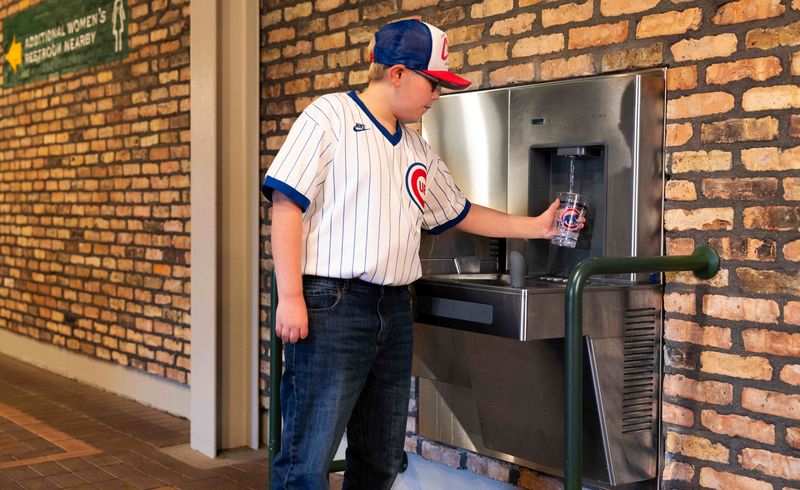
The Chicago Cubs have partnered with Sloan, a commercial plumbing company, since 2015 on water-efficient fixtures and other stewardship efforts across its footprint at Wrigley Field, the surrounding neighborhood and the club’s Spring Training facility in Mesa, Arizona.
As the Chicago Cubs’ Official Water Efficiency Partner, Sloan has the naming rights to the team’s Spring Training ballpark. Sloan Park is a virtual Sloan showroom, featuring Sloan integrated products that work together to provide a touch-free, hygienic and highly efficient system that reduces water usage by more than 30 percent. That’s critical in Mesa, considered one of the most water-stressed areas in the U.S.
The Chicago Cubs’ hometown has access to plenty of freshwater on the banks of Lake Michigan, but it also bears responsibility for protecting that asset and managing stormwater, which is arriving in increasing intensity thanks to climate change. It accomplishes that through elements such as green roofs, rainwater recapture, and other green and gray infrastructure.
Getting Started
In each of these cases, understanding the venues’ unique water uses and impacts, as well as the risks inherent in the surrounding watersheds, was key to maximizing water stewardship impact. The diversity of water challenges, along with the local nature of water, makes it a challenging sustainability topic. A one-size-fits-all approach won’t do.
Fortunately, a growing pool of resources is available to teams and venues looking to launch or refine a water stewardship plan. For example, the World Wildlife Fund and World Resources Institute offer free tools to help companies learn about their water risks. SCS Global Services, a worldwide leader in third-party verification of sustainability claims, recently introduced a certification standard for site-based water stewardship and resiliency that will help organizations maximize water stewardship at individual sites.
The Water Council’s WAVE suite of programs targets water stewardship at an organizational level, offering the only verified programs addressing water stewardship across the enterprise. Participants undergo independent verification by SCS Global Services, demonstrating that they are prioritizing water-related action where it matters most to build a more water-resilient operation.
As climate change heightens water challenges across the country, from flooding to water scarcity, the need for thoughtful water stewardship becomes more important than ever. Sports and entertainment venues have an opportunity to lead the way, raising awareness of the need for water-related action while enhancing their own resilience. That’s a win for everyone.